Pages

Thursday, November 1, 2012

Dr. Alfred Mark Burnham


The following is a short biography of Dr. Alfred Burnham that I came across in the Harbor History Museum research and resource room. This is just another fascinating item that you can find when you visit this room on Thursday morning from 10 to noon. The author’s name is not given.

Alfred Mark Burnham
“Alfred M. Burnham was born in 1824 at Pavillion, New York. He received his medical education at the University of Buffalo, graduating in 1852. In 1860, he went to Albert Lea, Minnesota, where he took up a homestead. “Dr. Burnham was the second assistant surgeon to the Minnesota 10th Regiment Volunteers during the Civil War.

Rachel Hord Burnham
“Following his marriage in 1866 to Miss Rachel Hord [editor's note: Rachel was his second wife, his first wife died in Albert Lea], Dr. Burnham went to Fort Steele, Wyoming, where he filled a contract for getting ties for the Union Pacific Railroad. Alfred Bismarck was born there.

“The family returned to Albert Lea where Clarence and Luella were born. Came a severe winter, plagued with diphtheria, and Dr. Burnham went from one distressed home to another. The strain broke his own health and in the spring he was ready to move to California. A traveler from Washington Territory passed through Albert Lea, displaying fruits and berries from the Northwest. Dr. Burnham was so amazed by the stranger’s account of Washington wonders; he boarded his family on a train bound for Tacoma.

They arrived in the Puget Sound area in 1884. Tacoma was their first home and a son Frank was born that year. Dr. Burnham purchased a 160 acre homestead at the head of Gig Harbor Bay later that year and moved his family from Tacoma in a row boat. [Editor's note: In 1886, Burnham purchased land at the head of the bay from pioneer Peter Goldsmith, who first came with Sam Jerisich. The next year, Burnham bought an adjacent twelve acres of land from Jerisich and John Farrague.]

First Burnham home at today's Donkey Creek Park


“Dr. Burnham was the first Gig Harbor doctor and also opened the first general store. He platted his land which became the nucleus for the town of Gig Harbor. He and Mrs. Burnham filed the plat for the original town of Gig Harbor on April 28, 1888. He also surveyed the rights of way for roads to Purdy and Olalla. [Editor's note: The new "City of Gig Harbor" platted by the Burnhams was the same land that the three founding fishermen -- Jerisich, Goldsmith, and Farrague -- had owned in earlier years, encompassing the land from today's Donkey Creek park to the Bogue Viewing Platform. Burnham placed a stone monument marking the two main streets of Front and Harbor, most likely at the corner of today's Harborview and North Harborview. For the first time, Gig Harbor had streets. Two months later, Jerisich, Joseph Dorotich, and John and Josephine Novak platted the town site of Millville, today's "downtown" area.]
“To induce settlement, he offered a free lot to anyone who would build a house providing it was painted white or some other light color.

“Through the influence of Dr. Burnham many settlers from Albert Lea, Minnesota, came to the harbor. The Gig Harbor Mill Company, formed from Albert Lea settlers, erected a sawmill on the west side of the harbor.
The Gig Harbor Mill Company was located
at the foot of today's Rosedale Street.
“He died in Gig Harbor in 1896 at the age of 72.  He is buried in the Gig Harbor Cemetery.”
Burnham store at the head of the bay. In addition to the store,
the building had a community hall for plays and recitals.


© 2012 Harbor History Museum. All rights reserved.

Wednesday, October 31, 2012

October 31, 1880, Sunday

On this day Emmett Hunt wrote in his diary "Rain.  Clear at night and some frost.  Went Gig Harbor and helped ... boat around home.  A fearful job." 

© 2012 Harbor History Museum. All rights reserved.

Thursday, October 25, 2012

The Fortnightly Club: the Oldest Club in Gig Harbor

The women's Fortnightly Club is the oldest club that is still active in Gig Harbor and on the peninsula.

Gladys Para wrote in May, 1984, that the Fortnightly Club was still active in the community at that time. In June, 2012, the women of the club continued their long tradition of  community service and gave two scholarships to Peninsula School District graduating seniors. 

This woman’s club has had a continuous history here since its founding in 1907. The club originally formed to provide the women in Gig Harbor with means to fulfill social and educational needs. But with the advent of World War I, it expanded to include patriotic and philanthropic service to the community. The services that they established 100 years ago, have over the years that followed, continued...as we see with the scholarships awarded to our students.

Fortnightly Club

On December 9,  1907 the nine women that formed the Fortnightly Club included Lenna Patrick, Mary Magoon, Dora McKee, Bessie Green, Lucy Goodman, Littie Secor, Amanda Carlson, Elsie Jacobson and Angela Uddenberg.

Lettie (Mrs. Franklin) Secor gave herself the task of historian of the club and kept a record of their activities for 35 years. Unfortunately Mrs. Secor’s carefully crafted entries were misplaced sometime in the late 1960/70s. So, there is no recorded history of that time despite the fact that the club never even temporarily disbanded during their community activities.   
Club members in the early years of the organization
In 1908 about a year after forming, the members started a library which was first housed in the basement of the Uddenberg residence, with several members taking turns on Saturday afternoons to act as librarian. The books had been donated by interested friends, and members. The collection then moved to the home of Dr. Tymms. When the Tymms moved away the library was transferred to the Kendall store. In 1919, Mrs. J. D. Fuller, who then owned the telephone system, consented to house the library at the telephone office where it remained for twelve years.  Afterwards, it was moved to the Sweeney store at the head of the bay. Eventually it was disbanded due to the school libraries growing, the Tacoma libraries easier reached by ferry, and the difficulty of restocking and housing the books.

 In October 1909 they joined the Washington State Federation of Women’s Clubs.

Club members having a swim at the sandspit
In the beginning, they met twice-monthly in the afternoon from September to May in members’ homes. For many years, the women walked or rode a buggy to the home where the meeting was to be held. The self-produced literary and musical entertainments and their enthusiastic patriotism during World War I exhibited their willingness to get things done. Not everything they did received public notice.

The club helped families with food, clothing, and sometimes their labor when necessary. They established the practice of encouraging college bound Gig Harbor students by giving them cash loans. The names of those students were lost with the loss of Lettie Secor’s records. However, it is known that a young woman graduating from Stadium High School in 1919 was provided with a loan of $100 to help her begin a lifelong teaching career.

In 1937, the Fortnightly Club received the Gig Harbor Improvement Club building for the payment of the outstanding mortgage. They installed the building's first electricity. In 1962 the Gig Harbor Yacht Club, then six years old, purchased the building. The club members then reestablished the practice of meeting in the members’ homes and could then turn what was used for the building’s expenses to better advantage of the community. “Probably the most photographed check in local history” was then presented to Ruth Bogue, president of the Gig Harbor Library Board. The check was for $3,000. 


© 2012 Harbor History Museum. All rights reserved.

Wednesday, October 24, 2012

October 24, 1880, Sunday

On this day Emmett Hunt wrote in his diary "Still it rains.  Put in the day doing nothing.  Wrote a few letters in PM and study some in evening."

© 2012 Harbor History Museum. All rights reserved.

Tuesday, October 23, 2012

Shipwright's Term of the Week:

Tumble Home: The inboard slant or curve of a boat's side above the waterline.


© 2012 Harbor History Museum. All rights reserved.

Monday, October 22, 2012

Nate's Shipwright word of the week...

TUMBLE HOME

The inboard slant or curve of a boat's side above the waterline.

(Source: Bates Technical College, Wooden Boat Building Program)
© 2012 Harbor History Museum. All rights reserved.
Thursday, October 18, 2012

The Mosquito Fleet of Puget Sound


The Gateway featured a new business on October 2, 2012, the Mosquito Fleet Winery in Belfair.  Their grapes are from Walla Walla but their winery is on Hood Canal. Jacy Griffin, one of the owners, is also a history buff and she is the one responsible for the particular boat featured as well as the story that is available when the QR (quick-response) code is scanned by a smart phone app.

Then today while I was shopping for greens at none other than Harbor Greens, I happened to see the bottles on the wine shelf. A woman passing me said that her relatives were part of the Mosquito Fleet and they, the Browns, operated the Otter, what she said was the first grocery store on water in 1909.  Well, in reviewing the book Mosquito Fleet of South Puget Sound by Jean Cammon Findlay and Robin Paterson it states: “The 87-foot, Portland-built Otter first towed barges for Renton Coal Company in 1875 and then ran competition with Zephyr and Messenger. Though badly damaged in a collision with the Hasalo off Des Moines in 1890, she was rebuilt and in 1892 became a Tacoma based floating store, making weekly rounds on the upper Sound. She was moored and abandoned on the Puyallup River in 1897.” So it appears that the boat used by the Browns was a second boat named Otter.

But that is neither here nor there. I will see if I can do more research on that in the future. But, let’s talk a little bit about how the small steamboats became known as Mosquito Fleet. As Findlay & Paterson put it in their book “…a fellow officer overlooking Elliot Bay and remarking as he observed all the boat activity that it looked like ‘a swarm of mosquitoes.’ The name stuck.

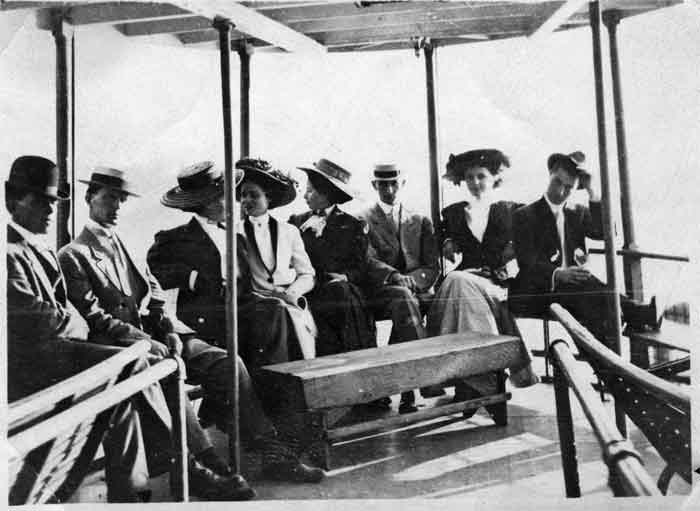
Passengers on the way to Arletta

Size, routes, propulsion, fuel, cargo, and jobs did not determine whether or not the boat qualified to be a member. In the beginning, the early steamboats were built with a flat deck, flat bottom, a wooden hull with a sharp bow, and a fine stern. The lower deck contained the engine and space for fuel (cord wood and later for fuel tanks), cargo, and passengers. As the engines gained more power and freight, the construction became more bulky.
Steamboat of the Mosquito Fleet landing at the Head of the Bay
Basically, a Mosquito Fleet boat was a boat of any size which could perform any job required on the Puget Sound. It was this fleet that was responsible for the communities and commerce which grew in the Pacific Northwest.

The Mosquito Fleet era ended when cars and paved highways became more available for the former customers of the steamboats. To survive, the fleet adapted with the larger boats becoming ferries and the smaller ones as tugboats, freighters, or excursion boats. Some didn’t survive; others were abandoned, burned, or scrapped and stripped of any and all salvageable materials.
The "Atalanta" - a Hunt steamboat


© 2012 Harbor History Museum. All rights reserved.