Pages

Thursday, December 3, 2015

Elmer Quistorff (August 10, 1907-September 26, 1999)


I happened to run across document entitled “Quistorff Family History” written in 1990 in the Harbor History Museum Research Room and was immediately curious as to why although I had seen the name somewhere had never heard anything about the man.

A quick search on the internet immediately pulled up an article from The Seattle Times dated October 2, 1999,  Elmer Quistorff, 92, Pioneer Fisheries Expert.  Since Gig Harbor is known as a commercial fishing village by people all over the world I find it interesting that he isn’t spoken off when we discuss famous Gig Harborites.  

So what follows is a greatly condensed version of his history taken from that original Quistorff Family History paper I referred to earlier.  Elmer wrote his version of the family from his memories and it was to become part of a more lengthy history started by his nephew, Kirk Quistorff, which reaches back to 1841. 

“I was born on August 10, 1907, in Tacoma, Washington, where my mother, Tessie, had lived with her stepfather Fritz Mensing, and where she and my father were married.  We eventually became a family of eight:  Mother, Father, my older brother Wallace William (Born November 7, 1905), myself, Ralph, John, Helen, and Fred, in that order.

Our mother was born in the Dalles, Oregon, daughter of Wolfgang Shreder and Therese Rosencratz.  When he father died, her mother married Fritz Mensing, who adopted her.  My mother’s mother passed away when my mother was 12, and my mother and her stepfather moved to Tacoma, where he married Christina Nuschler.  All four of those who made up my mother’s family were immigrants from Germany.

My treat-grandfather Fred Quistorff was an immigrant from Denmark (later Germany), and a carpenter by trade.  The language he and his wife brought to the United States was German.  My grandfather grew up in the Michigan-Wisconsin area, and like his father, became a carpenter and millwright.  My father also took up the carpentry trade and was working in Tacoma when he met and married my mother.  Fritz Mensing, my mother’s stepfather, was a carpenter and building contractor.  To carry the coincidence of craftsmanship background further, my father’s brother Adolph, also a carpenter, married Lydia Miller of Tacoma, whose father, Henry Miller, was likewise a contractor and builder.  Adolph’s son Albert became a carpenter, and my brother Wallace worked several summers as a carpenter for my grandfather Mensing.  My brother Fred also worked briefly at the trade.  

My parents moved to a logged-off area in what we referred to as Gig Harbor (now referred to as North Rosedale) in the fall of 1907.  My father and his brother purchased 16 acres from G. H. Wood (who continued to hold as his home the area north of our property extending down to Henderson Bay).  My father and Adolph divided the property between them, the north eight acres being ours.  

…. In 1927, my father purchased the 40 acres of land containing the water-wheel site, which was located about a quarter-mile east of the home place.  Here he installed a large hydraulic ram taking water from a spring on the hillside.  This delivered water to a 5000-gallon tank, which released gravity water to our house and a number of neighbors’. (NOTE:  G. H. Wood had erected a waterwheel on a small creek that ran through his property to provide water for his and both the Quistorff properties.  Elmer’s father had tw wells on his property including a 300-gallon tank.)  

… My brothers Wallace and Ralph and I attended Booster Grade School, which was located about a mile and three quarters south on the Purdy-Rosedale Road.  …This school was consolidated with the Rosedale district in 1919, the year Wallace was due to enter high school.  This was favorable timing as there was no high school closer than Tacoma.  With the consolidation it was possible to add the ninth and tenth grades to the Rosedale School, so that Wallace was able to continue his schooling without interruption.  …

Our father had provided much leadership during the consolidation.  Two years later, in 1921, he was instrumental in organizing a high school district that consolidated nine grade school districts, including Purdy, Elgin, Rosedale, Crescent Valley, Lincoln, Midway, Arletta, Wauna, and Artondale.  The consolidate high school district was centered in a new two-story brick building in Gig Harbor.  For the first several years, it took in seventh and eighth graders from those schools which by then were overcrowded.  …..

….We children were aged 15, 13, 8, 6, 4 and 2 when our mother passed away April 19, 1921.  For the remainder of that school year, Mrs. Blomley, who lived near the Purdy bridge, came in six days a week to be with the younger children and to do baking and washing, as our father had to continue working.  He drove to Purdy each morning to pick up Mrs. Blomley, and took her back again in the evening after returning from his work.  Wallace did the farm chores, milking and feeding the stock.  I helped get dinner underway, and mind the younger children.  

When school was out that summer, I took over caring for the children during the day.  Mrs. Blomley came in one day a week to bake bread and wash clothes.  Wallace often helped our father at his carpentry work.  When school took up in the fall, we resumed our spring schedule, until our father married Mary Murray in October that year.

Wallace and I both went to high school in Gig Harbor from the start.  This school met in the newly built community hall in Crescent Valley until Christmas time, then moved to the just completed high School building, centrally located between Crescent Valley and Lincoln schools.  When we entered, Wallace was in the eleventh grade, and I in the eighth (Rosedale was one of the grade school districts to share the high school building at the same time.)

The first senior class numbered two:  Millard Blakesley from the Elgin district and Ovid Grant, who came from Fox Island.  Ovid and his brother came by skiff to Warren each day to meet the bus that started from Arletta.  In Wallace’s graduating class, there were five students.  He was the only male and had the honor of being valedictorian.

Elmer continues talking more about his father and how he had become acquainted with the Murray family, and of course, Mary Murray who became their second mother.  How difficult and much changed life was following their father’s death in 1929, a mere 8 years after she and Elmer’s father married.  Raising the four younger children during the Depression without accepting any public assistance.  And he shares his memories on his stepmother’s life following the last two children’s graduation from high school.   There is a delightful memory of Wallace and Elmer’s adventures while growing up such as learning to swim, the heavy rains and landslides in 1915, the blizzard of 1916 and, of course bits and pieces about his brothers’ lives as they grew up and married.  He then continues with more on his own life after high school.

“… After high school and before, during and after my trip through the University of Washington, I was a commercial salmon and herring fisherman in Puget Sound and Alaska, worked on patrol boats for the U. S. Fish & Wildlife Service (then Bureau of Fisheries) in Bristol Bay, on the Kuichak, Naknek, and Egegik Rivers.  More of these experiences later.  

I married Anna Louise Sivesind at Cashmere, Washington, May 28, 1938.  She is the daughter of Claus William and Lena Sivesind of Seattle.  I met her while she was teaching school at the Gig Harbor Union High School.  We have a daughter, Nancy, born February 15, 1940, and a son, Ned, born December 2, 1942. ….

…. My work from 1937 through December 1949 was with the Washington Department of Fisheries, mostly at the Lewis River and Issaquah salmon hatcheries; from 1937 to 1938 it was connected with the fisheries problems created by the building of Grand Coulee Dam.  From Issaquah, I went to Okinawa, Japan, for three years, where I was in charge of the rehabilitation of the Okinawa fisheries.  This was followed by 2 1/2 years as a fisheries consultant for the Point Four program in Lebanon and Egypt.  Louise and the children were able to be with me during most of both tours.  Louise taught school at all three places.  She also taught for seventeen years in the Issaquah school system after our return from the Middle East in 1954.  

Back in Issaquah in September 1954, I undertook a project concerned with fisheries problems confronted in the proposed building of Puget Power’s Upper Baker River Dam.  These problems were unusual and called for solutions employed nowhere else where fish were affected by power dam construction.  The job lasted eight years, requiring an integration of my part as building of the dam progressed.

Following this, I went to the Department office, and I retired from the Olympia office in 1972.  While there, I was concerned with the planning and budgeting of a wide range of money sources for projects, such as my field work on the Baker River Dam, which were outside of regularly appropriated state funds.  For nine years, I drove back and forth from Issaquah to Olympia, a matter of 65 miles each way.

So, again we will skip a few paragraphs and jump down to his closing, and how his love of fishing dates back to his days as an eighth grader attending Gig Harbor Union High School (now Harbor Ridge Middle School) at the head of the harbor.  

“… When school opened each September, many small fishing vessels could be seen as they lay at their moorings on those calm waters below.  A mile from the school, the easterly and westerly headlands dipped toward each other to form a narrow inlet.  Through this gap could be seen a part of Puget Sound, the waters of West Passage (Colvos Passage) to the north, the Narrows to the south, and a part of Commencement Bay beyond.  Across these waters and further eastward, framed by the two headlands, the high school had an unobstructed view of Mt. Rainier and adjacent foothills.

Before the first week of school was over, we suddenly found that just overnight, the fishing fleet had vanished.  The first week in November, they were back again.  Again in December, they were missing.  These comings and goings were not as we saw them from our vantage point at the school.  Actually, during the latter part of the year, some of the vessels were back at their moorings again during the hours of darkness, these having been fishing in West Passage while we were at school.  

During the winter and spring, we seemed to take for granted the scene in the harbor as we saw it from the end of December to June.  Then, on a warm May day, we became aware of a stirring, that something was changing.  There was a faint fragrance drifting up to our heights on the hill.  The smell of newly tarred nets signaled the start of a new year of activity for the fishing fleet.

That wonderful smell will forever linger with me, as it became a starter for a series of activities and events that were to see  me in many out-of-the-way places, combined with unusual circumstances and people.  To cite a few:

  • Standing hip-deep in herring as I brailed 500 barrels of the fish, which filled up the hold and made a deck-load on the seiner Shenandoah, off the coast of Baranof Island in southeastern Alaska.
  • Alone on a 16-hour towboat up the Egegik River, tributary to Bristol Bay, a wide inlet from the Bering Sea.
  • A trip to the foundations of the Grand Coulee Dam on the Columbia River, to be sure that salmon could continue to pass upstream as the construction of that giant continued.
  • Eating dried squid with Okinawa fishermen on an outlying island, while inspecting the progress of their bonito boat construction.
  • Visiting the Temple of Baalbek in the Baka’s Valley of Lebanon.
  • Snapping a picture of the Rose Red City of Petra from a Jordanian Air Force plane, while the pilot circled so I could get the best view.
  • Spending the night at Mersa Matruh on the Mediterranean coast of Egypt, where Cleopatra is said to have seduced Mark Antony.

Elmer Quistorff died at age 92 and left behind a rich history as a pioneer fisheries expert.  He wrote a memoir for the University of Washington School of Fisheries, as well as technical books on fisheries biology.  I hope this brief view into his life as he recorded it spurs you on to find out more about his mark on fisheries around the world.  


© 2012 Harbor History Museum. All rights reserved.

Wednesday, December 2, 2015

Emmett Hunt's Diary Entry for December 24, 1884

Pretty fair day tho we have some sleet at night.  Ran to Tacoma & bro back a big load of young folks.

© 2012 Harbor History Museum. All rights reserved.

Wednesday, November 25, 2015

Emmett Hunt's Diary Entry for December 17, 1884

Still cold but not as bad as yesterday.  North wind still but somewhat lessened.  Passengers came in so at 10 we start & returned return at about 9:30 some rough but not very bad.  Considerable snow during day.

© 2012 Harbor History Museum. All rights reserved.

Thursday, November 19, 2015

Sheldon Lorenzo Stutz (11/10/1913-10/27/1988)


Sheldon L. Stutz was another one of the men that contributed much to our community.  His arrival in our town was not as early as many of the business leaders but that does not diminish his service, or his legacy.


A mailing to sent to all current and prospective clients by Stutz Fuel Oil Service


Unfortunately in the 27 years since his death his time in Gig Harbor has been overshadowed by the disarray and unkempt condition of his property on the corner of Soundview and west side of Harborview Drive across from The Tides.  

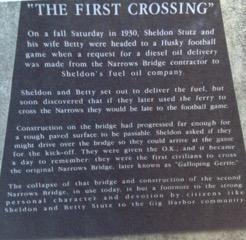
It is true that the Light Pole Park on the SW corner of Key Bank’s Property on Pioneer built by the members of the Gig Harbor Roatry Club and given to the City of Gig Harbor in 1998. This park was dedicated to him and to Galloping Gertie after his death in 1988.  Regrettably the information contained on the base entitled “The First Crossing” is not true.
This is the incorrect information, as explained below that we are working with the Gig Harbor Morning Rotary Club to correct

Cover of Program Dedication of Light Pole Park from HHM files
  • The Tacoma Narrows Bridge, known as Galloping Gertie, was not built in 1930.  The construction did not begin until 1938 so it would have been impossible to drive across it in 1930 on the way to deliver oil in Tacoma and then go to a Husky game at the University of Washington.
  • In 1930, Sheldon was a high school student in Pleasant Hill, Oregon, age 16 turning 17 in October of that year according to the 1930 US Census.
  • Following his high school graduation, Sheldon attended Wester Washington State College in Bellingham, WA where he received his Bachelor’s Degree.  He then enrolled in the University of Washington in Seattle and earned his Master’s Degree.
  • After graduation from university he taught school in PeEll and in Raymond, WA (According to 1940 US Census, he was in Raymond.)
  • Sheldon married  Betty (Elizabeth)and their first child, Del, was born in 1935.
  • Sheldon bought the Gig Harbor Shell Oil Distributorship facility from Harold Rehn in 1943.

I think it is important to bring this information to light based upon the numerous questions I have gotten from visitors and residents alike.  I have contacted the City of Gig Harbor regarding the misinformation and received the following reply:  “Thanks Tomi, I highly doubt anyone at the City fact-checked the information on the plaque when it was installed since the project was all through Rotary.  I’m glad you are in touch with Rotary since they are the ones who would need to change the information!”  I also contacted the Gig Harbor Morning Rotary Club who is also working towards correcting the plaque, and I received a note from their president on November 17, 2015, that their Community Service Team will start working on it immediately.  I’ll check back with them later this year.

Now that is out of the way, let’s concentrate on Sheldon and his contributions and leadership to our town.  Unfortunately my search revealed little, but what I found follows.

Sheldon was born in Farmington, Utah on November 10, 1913 but by the time he turned 6 the family moved to Heybrun, Idaho, and of course as we mentioned before, 10 years later the family was living in Pleasant Hill, Oregon.   

Sheldon had two brothers, Del LeGrand Stutz who was 2 years older and Rex L. Stutz, 5 years younger.  His father, Orson Stutz was a bricklayer in Oregon and his mother, Aurelia (Miller) Stutz was a home maker to the best of my knowledge.  Sheldon was the only member of his family to move from Oregon, first to continue his education, and then to live, teach school, and eventually own and operate a very successful business.

After high school graduation where “he excelled in academics and sports” according to his obituary, he left Pleasant Hill for Bellingham where he attended Western Washington State College (now Western Washington University).  After receiving his Bachelors Degree he attended the University of Washington (UW) where he earned his Masters.  While attending UW he taught school in Raymond and coached their basketball and baseball teams.

While a student he and Elizabeth (Betty) Hortense Holcomb (1918/2004) were married.  Elizabeth grew up in Eugene, Oregon, approximately 12 miles from Pleasant Hill and was living with her parents in 1935 before joining Sheldon in Raymond that same year..  They had two children, Linda Stutz Durham (1942-1969)  and Del L. Stutz (1935-present). 

In 1940s Sheldon moved his family to Gig Harbor, and in 1943 bought the Shell Oil Distributorship from Harold Rehn.  He owned and operated this distributorship and Stutz Fuel Oil until his his in 1988.

As well as his business operations, Sheldon served as Board member of the Peninsula Light Company for 25 years, and at the time of his death was the president.  He was also active in the Eagles Post #2809, and their first past president.  He was a past president of the Gig Harbor Lions Club, past master of John Paul Jones Lodge #271 and a member of Affifi Shrine Temple.
Obituary from Peninsula Gateway 


Obituary from Peninsula Gateway
© 2012 Harbor History Museum. All rights reserved.

Wednesday, November 18, 2015

Emmett Hunt's Diary Entry for December 10, 1884

Calm and very raw and cold.  Discharged our freight, recovered the guard astern of boat and beached her and repacked the stuffing (?) boxes.

© 2012 Harbor History Museum. All rights reserved.

Wednesday, November 11, 2015

Emmett Hunt's Diary Entry for December 3, 1884

Some sprinkle but a medium day.  After unloading freight awhile moved my woodshed.

© 2012 Harbor History Museum. All rights reserved.

Thursday, November 5, 2015

Thaddeus Lewis Waters (6/29/1835-6/28/1923)


I have often been asked if at the end of the Civil War did any Confederate soldiers settled in the greater Gig Harbor area.  My answer has always been not to my knowledge but we had a fair representation of Union veterans.   After a search through the Civil War veterans I found living in greater Gig Harbor, I found none from the South.  But, again, does that mean no Southern Confederate Veterans came to our area.  No!

A brief reading about the Alaska-Yukon-Pacific Exposition’s Dixie Day celebration honoring southern hospitality was held in Seattle on what is now the University of Washington campus, tells us it was well attended by several Confederate fraternal societies and their members.  I just have not been able to discover if any of them were Gig Harborites. 

The Union soldiers also had their fraternal societies.  The Grand Army of the Republic (G. A. R.) was formed after the Civil War ended mutual support and to stay in touch with their fellow soldiers and share their experiences.  In 1895, Joe F. Campbell, J. F. Campbell, Robert Miller, Miles B. Hunt, John Atkinson, William J. Duley, William Bishop, William Kimball, P. O. Allen, Annie Campbell, Annie Dow, Emeline Atkinson, Laura M. Allen, R. C. Allen, Chesney Dow, D. B. Atkinson, A. W. Young and H. W. Woodworth were granted permission to organize the H. R. Loomis Post, Grand Army of the Republic.  In 1904, Miles B, Hunt Aide de Camp of the H. R. Loomis Post, Grand Army of the Republic.   

The first G.A.R. Hall was built in 1892 on the waterfront.  Around the turn of the century it was moved to land donated by Sam Jeresich at Pioneer Way and Tarabochia and the structure expanded at that time.  After the G.A.R. disbanded, the building had a varied life-used for community center, dances, even funeral.  The first Masonic Lodge met there until they built their own building.  The Diocese of Olympia bought the building and it is where the Episcopal Church in Gig Harbor began, and the building’s name changed to St. John’s Hall.   

In about 1944, Lee Thrash and Judge Thurston bought the building, renamed it Town Hall.  It was then used as a real town hall, and drivers licensing headquarters.  Judge Thurston sold his interest in the building in 1958 and Thrash used it as a warehouse.

A short list of Gig Harbor area veterans includes Miles B. Hunt (NY), Thaddeus Waters (NY), Joseph Allen (NY), William Peacock (MA), Joseph Goodman (Bohemia), Alexander Wroten (Germany) and William J. Duley (IN), all of whom belonged to the H. R. Loomis Grand Army of The Republic (G.A.R.) Chapter #80.

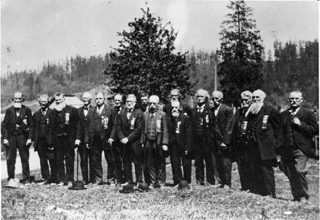
Before 1922:  GH members of the GAR, pose for photo in road by downtown church.  Included is Miles B. Hunt (5th from right), who served in Michigan Cavalry & discharged after receiving a head wound.  His friend & fellow member of Michigan Cavalry, Thaddeus Waters (4th from right).  Other veterans are Joseph Allen (1st from left), William Peacock (5th from left) and Joseph Goodman (10th from left-front row)
The Women’s Relief Corps, an affiliate of the GAR Veterans group and local women belonging included Mrs. Kingsbury, Mrs. Wroten, Mrs. Shyleen, Mrs. (Hunt) Patrick, Mrs. Hunt, Mrs. Atkinson, Mrs. Gillerman, Mrs. Allen, Mrs. Cruner, Miss Wroten.
Women Relief Corps Auxillary to GAR.  Front row:  Mrs Kingsbury, Mrs Wroten, Goldie Wroten & Mr. and Mrs. Shyleen. Second Row: Unk, Mrs. Lillie (Hunt) Patrick, M. B. Hunt, Martina Hunt, Unk, Mrs. Atkinson, John Atkinson; Third row: Unk, Unk, Unk, Unk, Art Kellermann,Unk, Unk, Unk, Mrs. Allen, Mrs. L.C.Cruner, Ukn, Mrs Wroten

A much longer list of Civil War veterans in our area includes the following.  But the listing does not designate Union or Confederate on the Tacoma-Pierce County Genealogical Society list of Veterans Graves in Pierce County.  However they all appear to have been born in a northern state or 3 in Canada which in my mind indicates allegiance to the Union cause.  But I am aware that there were a few Northerners who did not support the Union.  

In the following listing I’ve placed the birth state next to the cemetery name.

  • Jethro Bale - Artondale Cemetery, England
  • Joel Bever, Fox Island Cemetery, Ohio
  • Hannibal Bickford, Gig Harbor Cemetery, Unknown
  • Alfred M. Burnham, Gig Harbor Cemetery, New York
  • Willard Carney, Bayview Cemetery, Vaughn, New York
  • James Cole, Artondale Cemetery, New York
  • J. H. Deal, Bayview Cemetery, Vaughn, Pennsylvania
  • William B. Fairbairn, Longbranch Cemetery, Canada
  • Henry Fry, Artondale Cemetery, Indiana
  • Charles R. Gary, Artondale Cemetery, Wisconsin
  • John W. Gillerman, Artondale Cemetery, Wisconsin
  • Johannes Hofer, Artondale Cemetery, Unknown
  • Frederick F. Jacoby, Bayview Cemetery, Vaughn, New York
  • Hiram H. Rust, Artondale Cemetery, Canada
  • William H. Smith, Bayview Cemetery, Vaughn, Unknown
  • Alfred Van Slyke, Bayview Cemetery, Vaughn, Canada
  • There are others who may lived in our area but have been buried in the Old Soldiers Home in Orting or elsewhere that I could not identify.

A long list of names tells us very little about how the Civil War affected these men, and later, their lives in Gig Harbor.

So I thought I would tell you a little bit about one of the lesser known Union veterans, Thaddeus Lewis Waters who for a short time lived in Gig Harbor.  Why did I pick him?  Flip of a coin?  No, he just intrigued me because the only I knew about him was he wrote a book about his experiences as a POW of the Confederacy. 
He is incorrectly listed as Thaddeus J. Waters on Images of Michigan Newaygo, Michigan Civil War Veterans Stories and Biographies.  However the biographical information appears to correspond with other information that I have been able to discover in my research.
The Peninsula Gateway, May 28, 1966

Thaddeus was born in New York on June 29, 1835, and shortly after his birth the family moved west to Ohio.  Eighteen years later the family moved to Hillsdale County, Michigan where his parents, Harvey and Sarah Dunning Waters lived the rest of the lives. 

Thaddeus taught school his last year in Ohio and after moving to Michigan he continued to teach.  In his 20s, he purchased 40 acres of forest land which he cleared before building the first log house on the property.  It was used as hotel, store, post office, school house.  But later that summer he married Laura Jane Weaver, (May 27, 1855), and they lived in the house.  Thaddeus and Laura had three children:  Alpha Franklin (1856-1929), Theron Daniel (1858-1915), and Albert Joseph (1860-1933) before the outbreak of the Civil War in 1861. 

On August 15, 1862, Thaddeus enlisted in Co. G, 2nd Michigan Cavalry as a private.  His battalion  entered the war at Clarksburg, Virginia and fought their first battle at Perryville, Kentucky and then Thompson’s Station in Tennessee.  Unfortunately the third battle he was in at Chickamauga (River of Death)12 miles south of Chattanooga he was taken prisoner on September 20, 1863. 

He served for three years although the later part of those years was as a prisoner of war.   

As a prisoner his interment began with two months at Richmond ,Virginia, then transferred to Danville Virginia for six months and it was here a hostile rebel guard wounded him in the hip with a bayonet. The Confederate Army then decided to transferred him, along with several other prisoners, to Andersonville Prison in Georgia where he remained until the war ended.  When the Civil War ended the Union Army moved all their prisoners to Camp Chase, Ohio.  Thaddeus was discharged on June 16, 1865 from this camp.  

Thaddeus returned home to his family and he and Laura had two more children: Frank Elmer (1868-1888) and Hiram Joseph “Jay” (1878-1947).  

In 1865 Laura’s father, Daniel Weaver, traveled slightly west of Fremont to the White River looking for better power source and easier access to the logs he processed.  At his Fremont sawmill he had to haul the logs from where timbered to the mill.  At this location he could float the logs directly to the sawmill.  The area here was much flatter and drier than Fremont where the land was very marshy. So, in 1866, Daniel Weaver and another man, John Cook, built a sawmill on the White River where Oceana and Newaygo Counties met.   A dam was built on the river allowing his new sawmill to be operated by steam, and by 1911, electric power to be produced for the village.  In many ways, Thaddeus’ father-in-law is credited with creating a thriving lumber and logging town.   But Thaddeus played a big part working with his father-in-law.

That same year, 1866 after returning from Andersonville Prison in Georgia, Thaddeus and John Cook platted the new village, and it was named Hesperia.  The next year a post office was established in Weaver’s store; the following year, Weaver, Cook and another man, Hoskins, deeded blocks “O” and “P” to the public for the Hesperia Public Park.  By 1871, Weaver expanded his holdings by building a flourmill next to the White River.  Of course like all growing, thriving villages and towns they needed a newspaper which was founded by none other than Weaver’s son, Daniel L. Weaver.  During this  time Thaddeus continued to practice surveying, became the Township Clerk (City Clerk) and following that position by becoming the Drain Commissioner.

Thaddeus and Laura belonged to the Seventh Day Adventist Church, and Thaddeus was a member of the political Greenback Party.  According to Wikipedia, “the Greenback Party (known successively as the Independent Party, the National Independent Party, and the Greenback Labor Party) was an American political party with an anti-monopoly ideology which was active between 1874 and 1889.  The party filed Presidential tickets three times-in the elections of 1876, 1880 and 1884, before fading away.”

Fremont and Hesperia Michigan adjoin but from what I can tell, maintained their separate names.  Laura and Thaddeus continued to live in their house in Fremont.  It was there when on December 22, 1879 Laura died,but did she?  Here is where it becomes difficult to decide what is true and what isn’t.  The book, Portrait and Biographical Album of Newaygo County, Mich: states Laura died on December 22, 1879 in Hesperia, MI.  The 1880 and 1900 US Census, shows her as alive:  living in Michigan in 1880 and in Gainesville, Hall, Georgia according to Ancestry.com.  The Ancestry.com shows on her sons:  Hiram “Jay”, Theron “Daniel” and Albert family trees that Laura died on September 10, 1901 in Coalgate, Atoka, Oklahoma.  I’ve found some additional information about this “mystery”.  In notarized statements by both Albert and Hiram made on different days in November 1923 relative to Thaddeus’ estate.  

Both say that their mother died on September 10, 1901 in Oklahoma.  They go on to state that following Laura’s death, Thaddeus returned to Michigan where he married a former neighbor, Hannah A. Holcomb in Berrian, MI.  This was confirmed in an oral history given by his grandson, Leon Waters, Albert’s , son in November 1979.  “Well, not long after that (Laura’s death added by me) my grandfather went back to Michigan and he married somebody there and it was acquaint — not acquaintance — not an —we — no acquaintance of ours.  But I’ve seen her picture and know that she looked, well, substantial sort.  And, but, someway or other it didn’t last long.  I don’t know who, what, nor how — what happened.  But grandpa went out to visit his old comrade and friend Miles Hunt from Michigan.  They were close friends in the service.  And while he was there he took up a homestead and there spent the rest of his life there.  And, but, he was always busy with berries and small fruits and …” 

Thaddeus came to Washington in 1903.  Leon goes on in his oral history:  “…And — so now, that was after that that, in 1910 Hiram got acquainted with a widow in western Colorado, at our place, and wrote grandpa about it.  And grandpa wrote to this widow, Diana Sell.  And she accepted — she accepted it, and he sent her a ticket, and went out there and took care of him the rest of his life.”

Another comment made by Hiram’s son, James Elmer stated “Thad was afraid of her (Hannah, added by me) and came out west alone, but always sent money to her until informed of her death.”

Thaddeus and Diana were married in 1910; Diana’s husband Valentine Sell had died before Thaddeus met her.  Following their marriage Thaddeus and Diana lived together until his death.  (Diana was born +/- 1856).  The Waters buried at Artondale  are Thaddeus, Diana’s daughter, Bessie Nelson,  Hiram J., Albert J., and James Elmer.

I pick up the trail again in the 1910 US Census which reveals that a Phaddeyous T. Watters is living in Gig Harbor, faming berries.  Is this our Thaddeus Waters and his name spelled phonically by the census taker?  If I put Phaddeyous Watters in Google search, it tells me the name does not make any book results: do I mean “Thaddeus” Watters.  

The 1920 US census shows Thaddeus living in Gig Harbor remarried to Diana Sell and they the sole members of the household..  The US Census also shows Hiram Joseph “Jay”, the youngest son living in Schneider’s Prairie, Thurston County in 1930, his draft card for WWII shows him living in Olympia in 1942 and his death in Seattle in 1947.

Two sons never left Michigan.  Only 3 did, Hiram as mentioned above and Alpha Franklin who moved to Colorado, Kansas and died in Arizona.  And Albert Joseph who moved to Tennessee, Colorado, and died in California.  But surprising, Albert, Hiram, grandson James Elmer and step-daughter Bessie Nelson are all buried in the same plat at Artondale.

Let us close this blog by reproducing the Preface to Thaddeus’s book “The Terrors of Rebel Prisons” published by E. O. Shaw in 1891.

THE STOCKADE OF ANDERSONVILLE
by
An Old Andersonville Prisoner.
Of all stories which cause the blood to flows
Hot in the arteries of life to go;
Which arouse the passions, Stir up the ire,
Give stress to Liberty, our hearts desire;
Very few can compare, few fill the bill.
Like the great stockade of Andersonville
It's ghastly horrors of death and shame,
And human misery, beat every name
Written in history try, save that of him
Who built in Rome the Coliseum.
E'en Nero's cruelty can scarcely fill
The picture of death In Andersonville.
To Nero's cruelty is set as a foil.
The gladiators fight on the sandy soil;
The thousands who viewed the scene below,
Who jeered and shouted at human woe,
Nothing like this did our pulses thrill,
In the tall stockade of Andersonville.
Of human misery, it seemed the sum;
With it's wails of woes it's horrors glum,
It's starving thousands with hollow eyes,
Their bed the earth their roof the skies;
Could only cry to Him whose will
Was scarcely known at Andersonville.
Had the demons of Hell hold council below,
Their hatred vent, their HELLISHNESS TO SHOW:
They never could give to mankind a curse,
To kill and destroy, like the inhuman Wirz.
His face was the foil the picture to fill,
In the grim stockade of Andersonville
This story was written in order to prove,
Who was the patriot, his country to love;
Jeff Davis--or those whose blood has boon shed
On the fields of the South, and who are now dead;
Who endured the woe, whose hearts-blood did chill;
In the great stockade of Andersonville. --THAD WATERS.

References:
  • Ancestry.com
  • wikipedia-Grand Army of the Republic; Greenback Party
  • The Peninsula Gateway - March and April 1965
  • FindaGrave.com
  • Hesperia Centennial Souvenir Book 
  • Images of Michigan-Newaygo, Michigan Civil War Veterans Stories & Biographies
  • Portrait and Biographical Album of Newaygo Count, Michigan
  • Tacoma-Pierce County Genealogical Society of Veterans Graves in Pierce County
  • The Terrors of Rebel Prisons by Thaddeus Lewis Waters
  • Harbor History Museum Research Room
© 2012 Harbor History Museum. All rights reserved.